The Hampton Roads Leadership Farce: Everybody Has a Title, Nobody Has an Answer
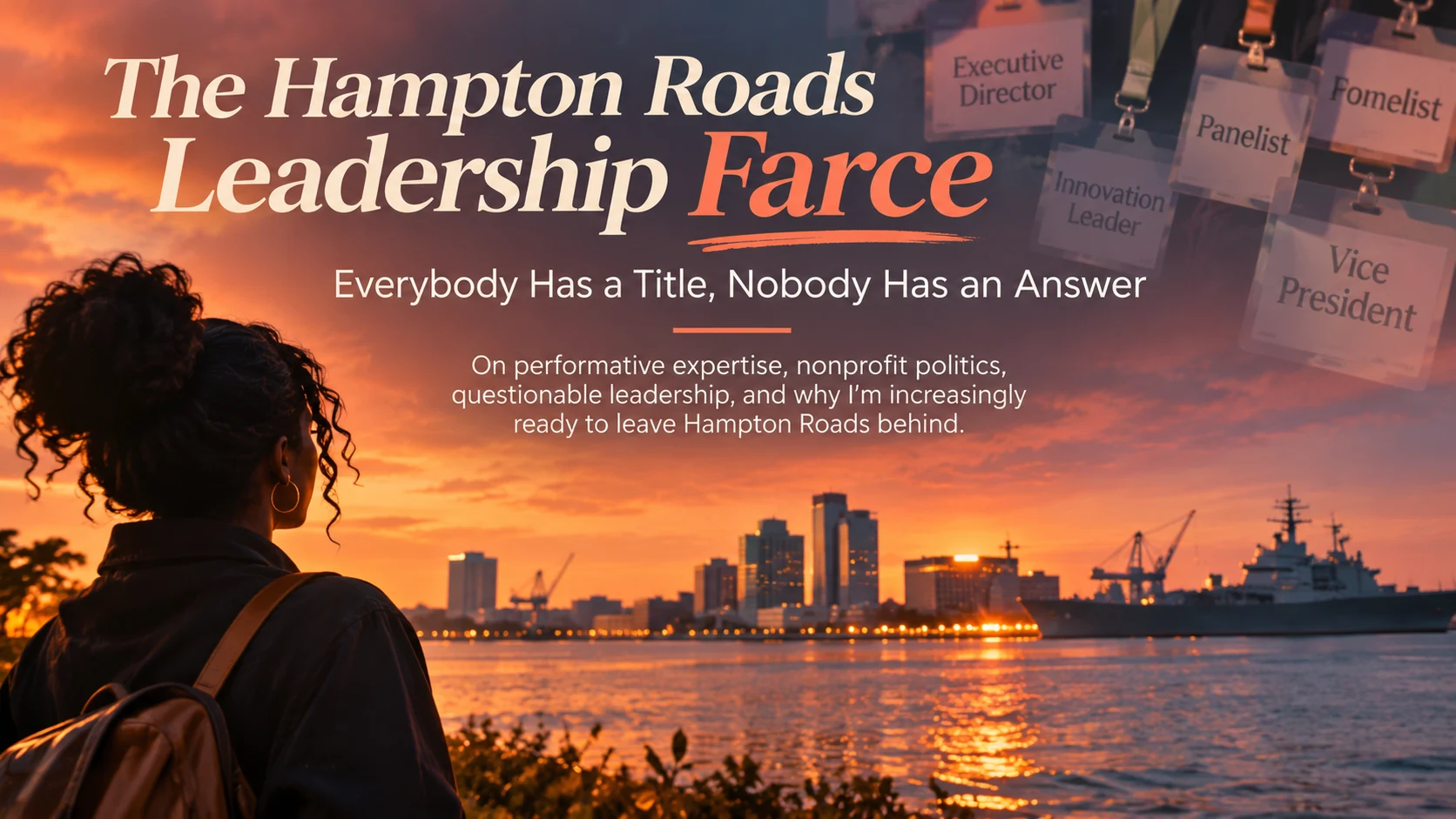
*On performative expertise, nonprofit politics, questionable leadership, and why I'm increasingly ready to leave Hampton Roads behind.*
I am becoming increasingly convinced that one of the greatest obstacles to professional growth in Hampton Roads is the professional culture itself.
Not the absence of talent. Not the absence of ambition. Certainly not the absence of networking events.
God knows we have enough of those.
I'm talking about the peculiar ecosystem of professional organizations, leadership councils, entrepreneurial initiatives, and innovation communities where seemingly everyone is an executive, founder, director, strategist, or subject matter expert.
Everybody is leading something.
Everybody is speaking on a panel.
Everybody is being recognized for something.
But what, exactly, are we accomplishing?
And perhaps more importantly, who is qualified to be leading these conversations in the first place?
Because after spending considerable time participating in professional organizations and community initiatives throughout Hampton Roads, I've developed a rather uncomfortable observation:
**We have created an environment where the performance of professional success can be more visible than professional success itself.**
And I'm tired of participating in it.
Hampton Roads Has a Leadership Title for Everybody
Spend enough time in professional networking circles around Norfolk, Virginia Beach, Chesapeake, and the surrounding cities, and you'll encounter an extraordinary number of people with impressive titles.
Presidents. Vice Presidents. Executive Directors. Founders. Community Leaders. Innovation Strategists. Business Consultants.
You would think we were living in a region overflowing with accomplished executives and industry pioneers.
Yet in the particular professional circles I've encountered, I've repeatedly found a disconnect between people's titles and their actual professional experience.
I've served in organizations where individuals held leadership positions despite having little experience managing people, overseeing substantial operations, or developing the kinds of professional relationships that could create meaningful opportunities for their members.
I've been subordinate to people whose organizational authority seemed to exceed their practical ability to lead.
And I've watched individuals speak confidently about industries in which they have never actually held a job.
I find this bizarre.
Not because unemployment is shameful.
Not because someone working an entry-level position cannot be intelligent, capable, or ambitious.
And not because people should be prohibited from developing leadership experience through volunteer organizations.
But because **there is a difference between developing leadership skills and presenting yourself as an established leader.**
And Hampton Roads desperately needs to become more comfortable acknowledging that distinction.
The Panels Are Becoming Ridiculous
I have personally participated in panels alongside people who, to my knowledge, had never worked professionally in the fields they were invited to discuss.
Think about that.
People are being positioned as voices of authority in industries where they have no direct employment experience.
And rather than being introduced as emerging professionals, enthusiasts, advocates, or people exploring a particular field, they're presented in ways that suggest established expertise.
Why?
What exactly qualifies someone to speak authoritatively about an industry?
Is it their education?
Their research?
Their professional accomplishments?
Their technical contributions?
Or is it simply that they're familiar to the people organizing the event?
Because sometimes, I genuinely cannot tell.
I'm pursuing technical education and developing my own interests in scientific research and computational biology. The more I learn, the more apparent it becomes that genuine expertise requires considerable time, discipline, and intellectual humility.
I would never presume that my interest in a scientific field makes me equivalent to someone who has spent fifteen years conducting research in it.
I know the difference between being a student of a discipline and being an authority within it.
Why does that distinction seem to disappear when someone gets invited to speak at a local professional event?
**Knowing the vocabulary of an industry is not the same as understanding the industry.**
And having a microphone doesn't change that.
The Nonprofit Leadership Problem Nobody Wants to Discuss
Professional nonprofit organizations are supposed to create opportunities.
They're supposed to help people build networks, develop skills, access mentorship, and advance their careers.
At least, that's what I thought.
But I've spent enough time in these organizations to start questioning whether some of them exist primarily to provide leadership titles to the people running them.
I've encountered leaders who lacked meaningful professional connections.
Leaders who couldn't provide substantive mentorship.
Leaders who struggled with basic organizational responsibilities.
Leaders who expected substantial contributions from volunteers while offering little strategic direction, professional development, or material support in return.
And yet the hierarchy remained.
The titles remained.
The expectations remained.
Everyone was still supposed to respect the organizational structure.
But why should a title automatically command professional deference when the person holding it cannot demonstrate the skills associated with the position?
I am not suggesting that every nonprofit leader needs to be a corporate executive.
Community leadership requires different competencies, and valuable work is often performed by people outside traditional professional pathways.
But leadership should still involve competence.
It should still involve accountability.
And when an organization claims to provide professional development, its leaders should be able to explain what opportunities they're creating and how members are benefiting.
Otherwise, what are we doing?
Are we building careers?
Or are we building résumés for the people at the top?
Our Innovation Culture Needs an Intellectual Reality Check
Recently, I helped organize and execute a hackathon in Hampton Roads.
The experience left me deeply frustrated.
Participants presented projects that involved technical concepts, research questions, and proposed solutions requiring thoughtful evaluation.
And I found myself listening to questions from evaluators that, in my view, demonstrated a limited understanding of what some of those projects were actually attempting to accomplish.
Some questions seemed designed to sound intelligent rather than to investigate the technical substance of the work.
There is a difference.
A useful question might challenge a project's methodology, technical feasibility, assumptions, scalability, or evidence.
A less useful question might simply repeat terminology from the presentation without demonstrating an understanding of its implications.
I heard too much of the latter.
And then came the results.
I disagreed strongly with the projects selected for recognition.
Not because I expected everyone to share my preferences, but because I believed other projects demonstrated more substantial technical reasoning and stronger potential.
I recognize that judging is subjective and that I may not have had access to every consideration behind the final decisions.
But the experience raised a larger question for me.
**How can a community claim to be cultivating innovation if the people evaluating that innovation cannot consistently demonstrate an understanding of the work?**
Hackathons are supposed to reward problem-solving.
They're supposed to encourage experimentation, technical development, and thoughtful approaches to real challenges.
But when the evaluation process appears to privilege superficial qualities over substantive work, we risk teaching participants the wrong lessons.
We teach them how to impress a room rather than how to solve a problem.
And that is not the same thing as developing technical talent.
The Same People, the Same Rooms, the Same Conversations
One of the things I've noticed about professional networking in Hampton Roads is how frequently the same people appear across different organizations and events.
The same speakers.
The same organizers.
The same leadership circles.
The same conversations about entrepreneurship, innovation, workforce development, and community impact.
There is nothing inherently wrong with an interconnected professional community.
But I sometimes wonder whether these circles have become so accustomed to validating one another that they've lost the ability to critically evaluate their own effectiveness.
Someone speaks at an event.
That appearance becomes evidence of expertise.
Their perceived expertise leads to another invitation.
That invitation becomes another accomplishment.
Eventually, the person has an impressive list of appearances and leadership affiliations.
But what has actually been built?
What measurable outcomes have been produced?
How many people have secured meaningful employment?
How many sustainable businesses have emerged?
How many participants have transitioned from introductory workshops into serious professional opportunities?
How many projects have moved beyond demonstrations and presentations?
And how much of the activity exists primarily to generate material for the next LinkedIn announcement?
I would genuinely like to see those numbers.
Because I am no longer impressed by attendance figures, photographs, or the number of organizations represented in a room.
I want to know what happened afterward.
I'm Tired of Being Asked to Volunteer My Way Into a Career
This is perhaps the most personal part of my frustration.
I've invested substantial time in community initiatives.
I've organized events, developed programming, supported technical projects, helped participants, and contributed skills that organizations would otherwise have to pay someone to provide.
I've done this because I believed in the value of community development.
I still do.
But belief does not pay bills.
And professional enthusiasm is not a substitute for financial stability.
There is something deeply frustrating about watching organizations benefit from volunteer labor while the people performing that labor struggle to translate their contributions into meaningful professional opportunities.
It's even more frustrating when the people receiving public recognition are not necessarily the people responsible for executing the work.
I am tired of being told that exposure is valuable.
I am tired of being encouraged to view every unpaid responsibility as an opportunity.
I am tired of being expected to demonstrate gratitude for access to rooms that have not meaningfully improved my circumstances.
At some point, we have to ask whether our professional development ecosystem is actually developing professionals.
Or whether it is simply creating an endless supply of unpaid labor for organizations that know how to market themselves.
**There is a point at which volunteering stops being an investment in your development and becomes a subsidy for someone else's professional image.**
And I am increasingly unwilling to make that investment.
I Want to Be Around People Who Know More Than I Do
I want to be very clear about something.
I do not believe I'm the most intelligent person in Hampton Roads.
Far from it.
There are extraordinary scientists, engineers, educators, entrepreneurs, and professionals throughout this region.
We have universities, research institutions, healthcare organizations, military installations, and businesses employing people with substantial expertise.
I know those people exist.
My frustration is that the professional networking spaces I've encountered don't always seem particularly effective at connecting emerging professionals with them.
Instead, I keep finding myself in environments where the people claiming authority are sometimes only marginally more experienced than the people they're supposed to be mentoring.
I don't want that.
I want to work with researchers who can challenge my hypotheses.
I want engineers who can critique my designs.
I want experienced executives who understand organizational strategy beyond writing a mission statement.
I want to learn from people who have built companies, managed substantial budgets, led complex teams, and delivered measurable results.
I want to be in environments where expertise is demonstrated rather than announced.
Where criticism is informed.
Where professional standards are high.
Where people can admit what they don't know without feeling threatened.
And where opportunities are connected to actual career advancement.
I don't need everyone around me to be successful.
But I do need to be around people who can help me understand what success in my chosen fields actually requires.
Maybe Hampton Roads Isn't Where I'm Supposed to Grow
I've lived with the idea that community involvement is an important part of professional development.
And I still believe that.
But I'm beginning to recognize that not every community can provide every opportunity a person needs.
I want to pursue scientific research.
I want to develop technical expertise.
I want to build things that have relevance beyond a local innovation showcase.
I want to contribute to organizations that operate nationally and internationally.
I want to be compensated for my work.
And I want to be evaluated by people who understand the disciplines I'm trying to enter.
I don't want another honorary position.
I don't want another panel invitation simply because someone needs a speaker.
I don't want another opportunity to perform unpaid administrative and technical labor under leadership that cannot provide meaningful professional direction.
And I don't want to spend my career becoming increasingly recognizable within a professional community while remaining economically stagnant.
**Local visibility is not the same thing as professional mobility.**
That's a distinction I wish I'd understood sooner.
Because being known by everyone in a room means very little if nobody in that room can help you get where you're trying to go.
I'm Ready for Something Else
Maybe this essay will offend people.
Maybe some will interpret it as arrogance.
Maybe others will insist that I should be grateful for the opportunities I've received.
But gratitude and criticism can coexist.
I can appreciate the people I've met and the experiences I've gained while acknowledging that the professional culture I've encountered has often disappointed me.
I can believe in community development without believing that every community organization is effective.
I can respect people as individuals without pretending they're qualified for every position they occupy.
And I can recognize the potential of Hampton Roads while deciding that my own future may require leaving it.
I'm not interested in spending the next decade collecting titles in organizations that cannot help me build the career I want.
I'm not interested in becoming another person whose professional identity is built primarily around speaking engagements, volunteer leadership, and networking events.
I want to do meaningful work.
I want to develop genuine expertise.
I want to work alongside people who challenge me intellectually and professionally.
And I want to live somewhere that offers opportunities commensurate with the effort I'm willing to invest.
Hampton Roads has plenty of people willing to call themselves leaders.
What I want to know is where they're leading us.
Because from where I'm standing, too much of this professional ecosystem seems to be going in circles.
**And I'm ready to go somewhere.**
Conversation
A little room for thoughtful questions and shared discoveries.
No approved comments yet. Start a thoughtful conversation below.